
Employee terminations are one of the most difficult responsibilities employers face and they rarely get easier with experience. In our recent webinar, Employee Terminations: Key Tips, Templates, and Pitfalls to Avoid, Ethena’s Chief People Officer, Melanie Naranjo, joined Medina McKelvey Partner Angela Rho to unpack the realities of termination decisions and how to navigate them with clarity, confidence, and care.
Category: Legal Updates
PAGA Reform: 5 Quick Things Employers Should Know

Below are five quick things employers should know about the PAGA reform currently underway in the legislature. While this is a preliminary assessment based on the limited information we have so far, we wanted to provide employers with the key takeaways from these developments. We will continue to keep you updated as this develops.
Hope on the horizon? A Deal to Modify PAGA Struck

Earlier today, the California governor, state legislative leaders, and business and labor groups announced a deal to reform the Private Attorneys General Act (PAGA), which will change the law while avoiding the ballot measure scheduled for later this year.
No Summer Vacation for Employers—Deadline to Complete Workplace Violence Prevention Requirements is July 1
Senate Bill 553, which amends Labor Code section 6401.7 and adds Section 6401.9 requires most California employers to establish and train on a Workplace Violence Prevention Plan no later than July 1, 2024.
Wage Rx: California Prescribes a Minimum Wage Increase for Healthcare Workers
The minimum wage for healthcare workers will increase on June 1, 2024, with the addition of Labor Code sections 1182.14 and 1182.15 (enacted by SB 525). Notably, this law expands the definition of healthcare employee to include most employees who work in healthcare settings, including, for example, janitorial or housekeeping employees.
No Joke—California Fast Food Workers’ Minimum Wage Increases to $20 per Hour on April Fools’ Day
The newest fast food worker law, California Labor Code sections 1474 -1477 (enacted by AB 1228), increases fast food workers’ hourly wages on April 1, 2024. The law requires fast food employers to pay fast food employees at least $20 per hour, establishes a Fast Food Council, and repeals the FAST Recovery Act.
We Are Never Ever Getting Back Together: California Declares Non-Competes Void and Requires Employers to Tell Employees About the Breakup by Valentine’s Day
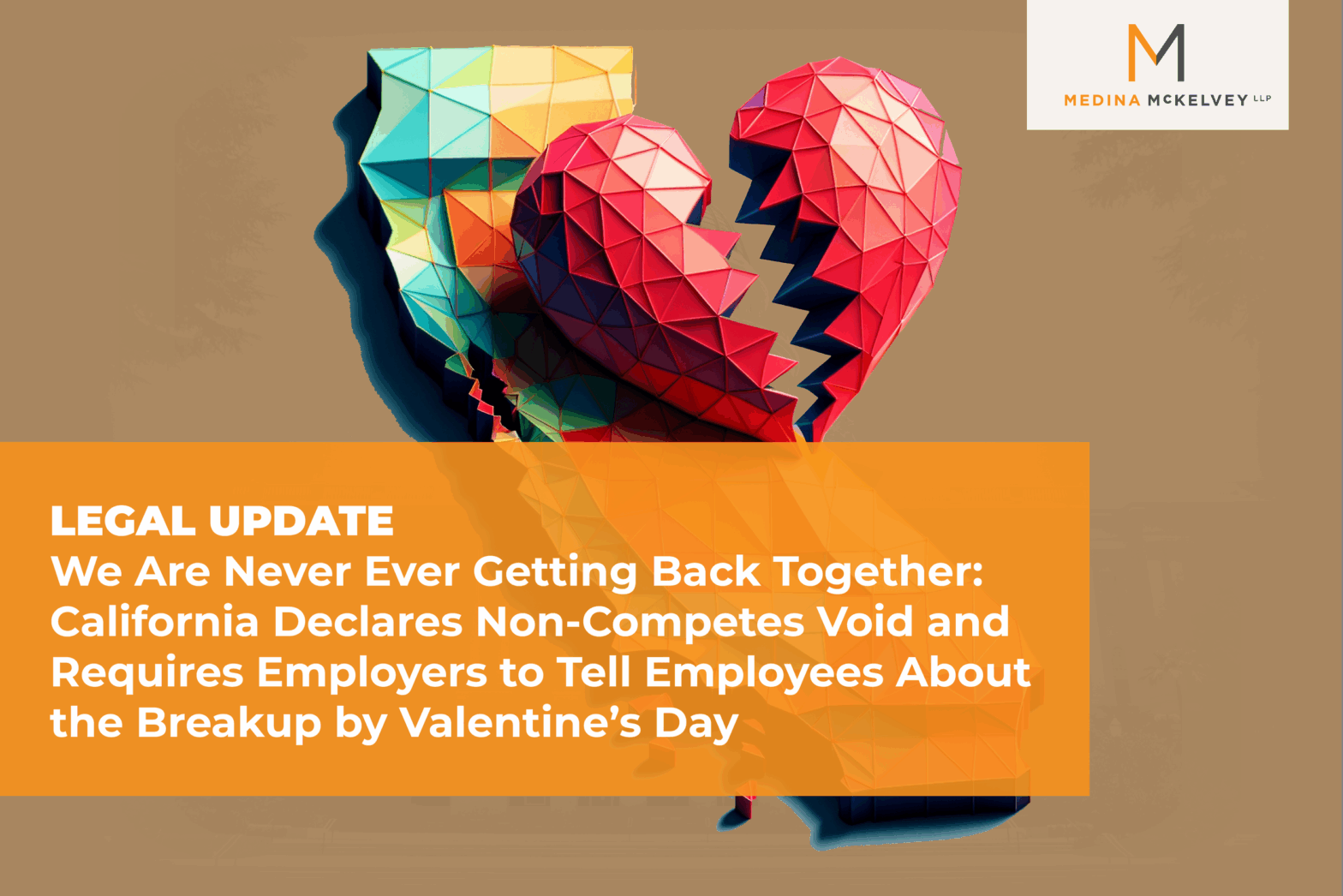
It’s time to officially break up with your non-compete agreements and tell impacted employees that the relationship status has changed. Recent California laws, Assembly Bill 1076 (“AB 1076”) and Senate Bill 699 (“SB 699”), which revised and added Business and Professions Code sections 16600, 16600.1, and 16600.5, have declared that such agreements are void and that employers clinging to these clauses will be penalized and could be sued by their employees.
Swept under the rug – the California Supreme Court’s Flooring Decision for Employers in Estrada v. Royalty Carpet Mills, Inc.
On January 18, 2024, the California Supreme Court tackled a divergence in appellate opinions regarding whether trial courts have inherent authority to dismiss a PAGA claim based on “manageability.” The Court determined that although trial courts can utilize several methods to effectively manage PAGA claims, they do not have the authority to dismiss such cases outright if they are deemed to be too intricate or time-consuming.
New Year, New Compliance Strategies: Comprehensive Wage Statement Review

As many of you know, California employment law compliance is not about good intentions—it’s about following the rules to the letter of the law. This holds true with employee wage statements (paystubs). Even seemingly minor violations of the Labor Code, like the wrong corporate address, can carry with them crushing penalties. These penalties apply to every employee, for every wage statement, for every pay period for up to a year until the violations are fixed.
California Minimum Wage Increase for 2024
The California Department of Finance published a letter on July 31, 2023, stating that the state minimum wage, which is currently $15.50 per hour, will be increasing to $16.00 per hour effective January 1, 2024, to account for inflation.